3 things today: psychological hacks of investor mindset

3 things today: investors (like other human beings) use mental shortcuts (called cognitive biases) in their decision-making process.

Top three shortcuts used include:

  1. confirmation bias (investors look for confirmation of their beliefs/values when evaluating startups and favour those with most “confirmations”)
  2. hindsight bias (investors think past successes of founders give them a good chance for a repeat success in future)
  3. bandwagon effect (investors jump on an investment opportunity that has other influential investors, advisors or founders with good track record).

Entrepreneur’s perspective: psychology of fundraising

The above quote is the truth. There is no one world – each of us lives in a world. And just like in anything, when it comes to money and fundraising for our projects, we live in our little world with our own idea of what an efficient fundraising process looks like. We do our research, then follow some steps we find convincing and voila! We fail. Generally speaking, startup fundraising is inefficient, lengthy and for most part fruitless, minus the few (statistical) exceptions. 95% of all startups launched die within the first 3 years, top second reason being shortage of capital. Capital is the oxygen to a startup, powering its launch and growth, and yet this oxygen turns out to be very hard to come by. 

Why do most startup fundraising efforts take long time and frequently fail? Two reasons: 1) founders don’t understand, let alone incorporate, behavioural insights governing investors’ decision making process into their pitch deck and pitching process; 2) investors fail to see salient points and potential of startups thanks to lack of their time and focus, and not in small part, lack of founders’ lack of investors’ decision making process and mindset. i.e. point 1 above. One fundamental insight helps solve both issues: most decision making (of investors and human being in general) is instinctively guided and controlled by mental shortcuts (called cognitive biases), without them even being aware of those.

What are cognitive biases? Cognitive biases are mental shortcuts. They are bits and pieces of human character and behaviours that evolved over thousands of years to help us survive, initially in the context of hunter-gathering against predators and in the wild nature. While much time has elapsed, these biases are still present with us in the modern world.

Broadly speaking, cognitive biases can be split into two types: information processing and emotional biases. Information processing biases are statistical, quantitative errors of judgment that are easy to fix with new information. Emotional biases are much harder to change or fix as they are based on attitudes and feelings, consciously and unconsciously. Both types can have implications when you are a startup founder trying to fundraise because they operate to keep you within your comfort zone. The underlying belief that you’ll be safer, more secure and more comfortable with less uncertainty and risk dominates decision making. To fundraise efficiently and effectively, we need to do the opposite, by going after investors and selling our story (narrative bias), showing our vision (confirmation bias, clustering illusion) and getting them to buy into our team (halo effect) and product (distinction bias, zero-risk effect, pro-innovation bias).

Top seven biases that are critical for successful fundraising cover all aspects of successful pitch and pitching process. Entrepreneurs would be wise to incorporate these insights into their pitch decks, giving them the best shot at achieving their fundraising targets.

  1. Narrative fallacy. What is it: humans (including investors) have a tendency to look back at a sequence of events, facts or information in a linear and discernable cause-and-effect way. Cause-and-effect morph into a story. How to apply: make your pitch deck – at least the beginning part talking about Problem, Opportunity and Solution – into an inspiring story, with clear causes, effects and inspiration.
  2. Clustering illusion. What is it: investors tend to observe patterns in what are actually random events. How to apply it: you must showcase your team’s credentials, previous or relevant successes of exiting (or failing) startups or a successful career in an MNC, which will create a clustering illusion in an investor’s head that your team has been on a roll, and your current project’s vision will be achieved based on your team’s previous success. Also when you show traction/data to investors, make sure your case is compelling enough, even with little data using the clustering illusion to your advantage, by citing trends as validation of your vision.
  3. Confirmation bias. What is it: investors believe what they believe based on experiences and expertise they have accumulated in startup investing. How to apply it: include all the main points investors expect to see in your pitch deck, resulting in an investor “confirming” that your project is commercially sound and to have a serious consideration of investment. Lastly, in your deck, show your present solution as consistent with investor’s prior beliefs (i.e. in line with the investor’s current former portfolio investment) and avoid contradicting any strongly held opinions of the investor during pitching. 
  4. Pro-innovation bias. What is it: novelty or “newness” are generally considered good by investors, hence showing a product innovation is a good idea. How to apply it: Pitch innovative features of your product and how they give you an edge over competitors, especially a competitive advantage. However, a caveat – investors know this well – is that you need to be very careful when pitching a business model innovation, as investors’ inclination is towards favouring business models that have proven track record, as opposed to completely new ones. 
  5. Halo effect. What is it: this is the psychological tendency many people (including investors) have in judging others based on one trait they approve of. This one trait leads to the formation of an overall positive opinion of the person on the basis of that one perceived positive trait. For example, people judged to be “attractive” are often assumed to have other qualities such as intelligence or experience to a greater degree than people judged to be of “average” appearance. How to apply it: show (in the pitch deck) or inform (during pitching) of achievements (former exit, speaking at a prestigious event, etc) in order to create a halo effect in an investor’s head, which will then colour his/her judgment positively for the overall project, and in conjunction with other factors, might lead to an investment. Also, if you can show a testimonial by a celebrity or a well-known business person of your product or one similar to yours, halo effect will do the rest!
  6. Zero-risk effect. What is it: this is a tendency to prefer the complete elimination of a risk even when alternative options produce a greater reduction in risk (overall). How to apply it: in your pitch deck, it is important to either not show potential risks (scale up or product) or show a risk with a full mitigation of it. This is one of the main reasons that investors might not speak out or question you, but also decide not to go ahead with investment due to perceived risks in your product.
  7. Distinction bias. What is it: this is a tendency to view two options as more distinctive when evaluating them simultaneously than when evaluating them separately. It can magnify the near meaningless differences between two very similar things to the extent they become decisive in which one we choose. How to apply it: in your pitch, compare your product with one or two competing products next to which yours has clear benefit. This comparison will clearly sway the investor to your product as a preference. 

more complete list of biases (excluding the ones mentioned above) affecting entrepreneur’s pitching ability can be found below.

  • availability heuristic
  • information bias
  • expertise trap
  • attribution error
  • framing bias
  • bandwagon effect
  • hyperbolic discounting
  • sunk cost fallacy
  • planning fallacy
  • omission bias
  • choice-supportive bias
  • illusion of truth effect
  • superiority bias
  • self-serving bias

Cognitive biases are particularly challenging for fundraising process as they have a profound impact on the creative right-side brain which is critical for creative ideas. Right brain thinking is more risky and prone to biases as it deals with abstract unknowns vs. left brain thinking which deals with more logical concrete knowns.

*This article was first published on WholeSale Investor

3 things today: survive the survivor bias

3 things today: Let’s talk about Survivorship Bias. 

Why do we read and reread books/articles like “The Morning Habits of Successful People” or “The Six Characteristics All Billionaires Have in Common”? How many of these articles have you clicked on?

We love the idea that by learning about our idols, we’ll be able to emulate their success. A quick Google search of “Successful founders who dropped out of college,” gives names such as Steve Jobs and Mark Zuckerberg as all examples of entrepreneurs who had an idea, took a leap, and became successful.

But by equating their success to hard work alone, we ignore a very important fact: for every successful college dropout, there are hundreds, if not thousands, who weren’t as lucky.

The founders we put on pedestals worked hard, but there were also many circumstantial events that paved their way to success. In fact, research shows the majority of the United States’ most successful businesspeople graduated college – 94%, to be exact.

1) Better and cooler products don’t necessarily succeed – check TiVO, which is still barely alive

2) Don’t neglect external factors that influence success – see how Skechers kicked Adidas from top position

3) Just because you don’t hear you customer complain doesn’t mean they are happy – many customers leave before they complain of their unhappiness  

You must consider the other variables not immediately visible to you to avoid the survivorship bias.

3 things today: efficiency tools

What are your top 3 tools/mental hacks you use to be super efficient with your clients/at work?

For me, they are:

1) 80/20 approach to client work/communication.

2) taking meeting notes (in a pocket-size Moleskine OR in an email thread to the client to send immediately after the meeting) and ALWAYS putting action items to follow each meeting.

3) use Parkinson’s law (“work expands so as to fill the time available for its completion”) when allocating time to complete tasks, i.e. give short/challenging timelines for tasks.

Economics, psychology and blockchain systems

Blockchain platforms are economic systems. And just like any economy, a blockchain requires that its designers define monetary policy (inflation), fiscal policy (block size), taxation (fees), voting (governance/upgrades), and provide for the common defence (securing the network). Yet, unlike traditional economies, they offer the possibility of greater freedom and transparency because they avoid the problems of centralisation and concentration of power.

So the blockchain is great for academic economists, because it is a kind of living economic laboratory. Economists have plenty of tools for designing such systems. Does it end there? No, because the blockchain does not evolve randomly but by attempts at designing new, and better, models for money, ownership, control, trade, lending, licensing, and investment. In other words, many of the key innovations of the blockchain are economic innovations, and that means we need economists to help design them.

The problem with traditional economics is that it has two major assumptions, based on which the entire economic system is built. First, it assumes humans are rational and always and consistently optimise their utility (happiness, satisfaction). Second, economic theory assumes that on macro economic level there is or tends to be an equilibrium or balance which economics systems need to attain. In other words, we assume wisdom of the crowds and efficient market hypothesis. But what if neither is true, at least some times?

Humans are irrational by design. Just look at some of the decisions each of us make on a daily basis. We may vote for policies that go against our own economic interests. We make food selections that are at odds with our physical health. So there’s no clear, codeable logic in much of our behaviour.

Blockchain systems are, by design, difficult to change once deployed. Repairs and improvements to these systems are difficult. Protocols with billion-dollar valuations could disappear overnight. Things can get very acrimonious. Check the infamous Bitcoin block size debate. And one of the most difficult aspects for blockchain platform creators is accurately predicting people’s behaviour. That would be a relatively easy task if humans had a consistency, rational behaviour or an overarching logic in how they go about their lives.

Good news is that there is an entire field studying this – human irrationality and how to incentivise humans – very phenomenon, including Nobel laureates Daniel Kahneman and Amos Tversky and former Clinton advisor Cass Sunstein, who discovered that changing the default setting from “opt-in” to “opt-out” on things such as organ donation on a driver’s license and 401k contributions at work could dramatically improve uptake. This seemingly little change tapped on our Default Bias, enabling individuals to adjust their contribution levels (to retirement), but even the flummoxed novice who did nothing is at least socking some money away for retirement and taking advantage of company matching payments.

It turns out that we have a huge number of cognitive biases and knowing these and knowing how to go around these or nudge or incentivise us to act in desired ways is the key to understanding and predicting human behaviour accurately. One of most commonly-observed cognitive biases is loss aversion. Loss aversion derives from our innate motive to prefer avoiding losses rather than achieving similar gains. Kahneman and Tversy conducted an experiment asking people if they would accept a bet based on the flip of a coin. If the coin came up tails the person would lose $100, and if it came up heads, they would win $200. The results of the experiment showed that on average people needed to gain about twice (1.5x – 2.5x) as much as they were willing to lose in order to proceed forward with the bet (meaning the potential gain must have been at least twice as much as the potential loss). However, from traditional economic theory perspective, one’s risk appetite to losing or gaining $100 is the same.

The most tangible of incentives on blockchain platforms are digital tokens. Tokens usually represent currency, digital asset or some form of value in given blockchain system. Getting incentives right is fundamental to network growth, reflected in increased token adoption that yields positive network effects. Once this flywheel gets started, it serves as the ongoing funding mechanism for future development. Without it, the network cannot achieve self-sustainability. The value of the community and the token is what incentivises new members to join initially. If that value is off, new people don’t join and a death spiral begins. Once members are in, there needs to be a sustainable and growing value in the system to keep them using the tokens, participating in the community and helping the system grow. While token was the allure, the incentive system needs to account for conflicting interests of different types of users, system changes and perceived value and expectations from the system and, most importantly, it cannot necessarily based on the value of token itself. There are a few systems that help evaluate blockchain projects, including T3CG framework which is pretty solid.

Cryptoeconomics is hard as it requires expertise and mastery of mechanism design, contract theory, game theory, behavioral economics, public policy, macro-economics, and a solid understanding of decentralized technology in order to the design robust, sustainable and valuable blockchain economies. Hence is boils down to designing  incentive systems based on known biases – default bias, endowment effectbandwagon effect, etc –  and other factors, including cultural values, public policies, system-specific goals.

I am very excited by potential of blockchain systems but also humbled by the realization that we have just scratched the surface on how to build optimal blockchain systems.

Consciousness, quantum physics and Buddhism

What is consciousness?

And how do I really know you are conscious? This is the problem of solipsism. I know your brain is very similar to mine as you look like a human, sound like one and give an expression of someone with brain like other humans. By mathematical induction then, there is a perfectly reasonable inference that you too are conscious.

Some 10,000 laboratories worldwide are pursuing distinct questions about the brain and consciousness across a myriad of scales and in a dizzying variety of animals and behaviours. According to most computer scientists, consciousness is a characteristic that emerges from of technological developments. Some believe that consciousness involves accepting new information, storing and retrieving old information and cognitive processing of it all into perceptions and actions. If that’s right, then one day machines will indeed be the ultimate consciousness. They’ll be able to gather more information than a human, store more than many libraries, access vast databases in milliseconds and compute all of it into decisions more complex, and yet more logical, than any person ever could.

Consciousness could be explained by “integrated information theory,” which asserts that consciousness is a product of structures, such as a brain, that can store a large amounts of information, have a critical density of interconnections and thus enable many informational feedback loops. This theory provides a means to assess degrees of consciousness in people, animals (lesser degree than humans) and even machines/programs (for example, IBM Watson and Google’s self-taught visual system). It proposes a way to measure it in a single value called Φ (phi) and helps explain why certain relatively complicated neural structures don’t seem critical for consciousness. For example, the cerebellum, which encodes information about motor movements, contains a huge number of neurons, but doesn’t appear to integrate the diverse range of internal states that the prefrontal cortex does.

The more distinctive the information (of the system), and the more specialised and integrated the system is, the higher its Φ (and anything with a Φ>0 possesses at least a shred of consciousness). Over the past few years, this theory has become increasingly influential and is championed by the eminent neuroscientist Christof Koch. The problem is that even though Φ promises to be precise, it’s so far impossible to use it for practical calculations related to human or animal brains, because an unthinkably large number of possibilities would have to be evaluated.

Accordingly, consciousness is a property of complex systems that have a particular “cause-effect” connections. If you were to build a computer that has the same circuitry as the brain, this computer would also have consciousness associated with it. It would feel like something to be this computer, like each human does. Hofstadter’s Mind’s I has a collection of essays about mind (an emerging property of brain function) and how feedback loops are essential for this emergence.

Another viewpoint on consciousness comes from quantum theory, the most profound and thorough theory about nature of things. According to the orthodox Copenhagen Interpretation, consciousness and the physical world are complementary aspects of the same reality. When a person observes, or experiments on, some aspect of the physical world, that person’s conscious interaction causes discernible change. Since it takes consciousness as a given and no attempt is made to derive it from physics, the Copenhagen theory postulates that consciousness exists by itself but requires brains to become real. This view was popular with the pioneers of quantum theory such as Niels Bohr, Werner Heisenberg and Erwin Schrödinger.

The interaction between consciousness and matter leads to paradoxes that remain unresolved after 80 years of debate. A well-known example of this is the paradox of Schrödinger’s cat, in which a cat is placed in a situation that results in it being equally likely to survive or die – and the act of observation itself is what makes the outcome certain.

The opposing view is that consciousness emerges from biology, just as biology itself emerges from chemistry which, in turn, emerges from dissipative systems, according to physicist Jeremy England. It agrees with the neuroscientists’ view that the processes of the mind are identical to states/processes of the brain. It also agrees with a more recent interpretation of quantum theory motivated by an attempt to rid it of paradoxes, the Many Worlds Interpretation.

Modern quantum physics views of consciousness have parallels in ancient philosophy. For example, Copenhagen theory is similar to the theory of mind in Vedanta – in which consciousness is the fundamental basis of reality, on par with the physical universe. On the other hand, England’s theory resembles Buddhism as Buddhist hold that mind and consciousness arise out of emptiness or nothingness.

A strong evidence in favour of Copenhagen theory is the life of Indian mathematician Srinivasa Ramanujan, who died in 1920 at the age of 32. His notebook, which was lost and forgotten for about 50 years and published only in 1988, contains several thousand formulas, without proof in different areas of mathematics, that were well ahead of their time. Furthermore, the methods by which he found formulas remain elusive. He claimed they were revealed to him by a goddess while he was asleep.

Thinking deeper about consciousness leads to the question of how matter and mind influence each other. Consciousness alone cannot make physical changes to the world, but perhaps it can change probabilities in the evolution of life and thus quantum processes? The act of observation can freeze and even influence atoms’ movements, as shown in 2015. This may very well be an explanation of how matter and mind interact.


Creepy or cool? some AI breakthroughs and formula of life

You keep on hearing about AI is bad and once AGI is around, it will kill us off – paperclip maximization principle is a telling example? Check the below tidbits pushing the envelop.

Music

Historically, people line up to attend concerts of famous artists. Now, there is AI that generates pure gold jazz or what sounds like a mix of jazz and classic. Would you line up to hear these pieces? Would you still line up if you didn’t know whether it’s an algorithm or a human?

Fiction

Do you like Harry Potter? What about this Harry Potter? This algorithm learnt from the first few chapters of J.K.Rowling’s Harry Potter and created a novel of its own. Forget about J.K.Rowling, move on.

Film

TV series are great. Here is a script of Silicon Valley, generated by AI. Or a credibly-looking video from few dozen words (and some prior video training). Hollywood took heed.

Human behaviour

MIT researches created their AI system, which predicts human behaviour by approximating human “intuition” from myriads of data, and pitted it against human teams at data science competitions. The algorithm didn’t get the top score but it beat 615 of the 906 human teams competing. In two of the competitions, it created models that were 94% and 96% as accurate as the winning teams. Whereas the teams of humans required months to build their prediction algorithms, this algorithm trained 2-12 hours.

Cannibalism

Once virtual Adam and Eve (AI bots) were done with apples, they ate Stan, an innocent bystander (another AI bot) that happened to look like an apple.

Formula of life

OK, all the above are creepy, cool, scary, depending on your knowledge, interest and approach to life. But could these AI concepts eventually yield or create actual or natural life forms?

Even Artificial Life community acknowledges that the definition of “life” is contentious.

What Darwin’s theory talks about and what we believe is that there is clear difference between living organisms (in how they come to be and evolve) and everything else (from water vortexes to AI systems to coastal lines of England). Popular hypotheses credit a primordial soup, big bang and a colossal stroke of luck for creation of of life. Erwin Schrödinger framed life merely as physical processes in his treatise “What is Life?”.

But till now we had hard time explaining how (open) thermodynamic systems like our universe and even Earth evolved and how lifeforms evolved in them. We have answers for (close and weak open) ones. Till now.

According to Jeremy England from MIT given it a thermodynamic framing: it’s all about entropy (to create life, one has to decrease entropy). Carbon is not God. In his view, there is one essential difference between living things and inanimate chunks of carbon atoms: the former tend to be much better at capturing energy from their environment and dissipating that energy as heat. He has math formula, which indicates that when a group of atoms is driven by an external source of energy (like the sun) and surrounded by heat (like the ocean or atmosphere), it will often gradually restructure itself in order to dissipate increasingly more energy. This implies that under certain conditions, matter may acquire key physical attribute associated with life.

Now back to AI craze above. Imagine if we could introduce systems that artificially decrease entropy in AI systems as per Jeremy England’s prescriptions, near future could see a new Cambrian explosion of artificially constructed forms of life, which are….. songs, movies, fiction, ….. and perhaps new and better beings!

Here are more creepy/cool AI applications or here. Enjoy!

P.S.  Ralph Merkle think of Bitcoin as life:

Bitcoin is the first example of a new form of life. It lives and breathes on the internet. It lives because it can pay people to keep it alive. It lives because it performs a useful service that people will pay it to perform. … It can’t be stopped. It can’t even be interrupted. If nuclear war destroyed half of our planet, it would continue to live, uncorrupted.

Two extremes in blockchain-sphere illustrate current state

How do you know how well an industry/technology/product/.. does?

One way to check is to find out the two contextual (from economic, technological, social, …other perspectives) extremes of that industry/technology/product/…

Let’s have a go at Bitcoin/blockchain.

If you go to Etherscan, click on top menu item Tokens and then View Tokens, and if you search for “fuck,” below is the screenshot from few days ago.

Screen Shot 2018-04-14 at 2.03.53 PM.png

This of course is just one extreme, negative one, illustrating at once absurdity, creativity and ambition one can find in crypto space. While some of those tokens are placeholders, some like FUCK Token have a website and give an impression of an upcoming product. The F-word derived tokens allude to Facebook and Ethereum. Unsurprising.

For a positive extreme, check out DeepRadiology, which employs both deep learning (Yan LeCun, father of deep learning, is their advisor) as well as blockchain to “applying the latest imaging analytic deep learning algorithm capability for all imaging modalities to optimize your facility service needs.

Screen Shot 2018-04-14 at 2.12.29 PM.png

DeepRadiology uses AI to process myriads of data and blockchain to store and distribute it efficiently and effectively. Both time to process, for example, a CT scan and relevant costs are an order of magnitude less than the incumbents. Everyone wins.

And while Q1 2018 was bearish for all cryptocurrencies, whether rest of 2018 will be bearish or bullish is still a question. Either way,  due to maturing crypto market, more educated/pragmatic crypto investors/enthusiasts and less easy-to-get crypto, the focus is now on technology itself, which is what’s needed, in long-term.

Lastly, for your education – and entertainment! – have a read of this list of 100 cryptocurrencies described in 4 words or less.

Bitcoin: how many exist, lost and its quantum computing future

Let’s start by setting up a context of just how much it costs to verify one Bitcoin transaction. A report on Motherboard recently calculated that the cost to verify 1 Bitcoin transaction is as much electricity as the daily consumption of 1.6 American Households. Bitcoin network may consume up to 14 Gigawatts of electricity (equivalent to electricity consumption of Denmark) by 2020 with a low estimate of 0.5GW.

There is much written about theft of Bitcoin, as people are exposed to cyber criminals, but there are also instances where people are losing their coins. In case of loss, it’s almost always impossible to recover lost Bitcoins. They then remain in the blockchain, like any other Bitcoin, but are inaccessible because it’s impossible to find private keys that would allow them to be spent again.

Bitcoin can be lost or destroyed through the following actions:

Sometimes, not only individuals but also experienced companies make big mistakes and loose their Bitcoins. For example, Bitomat lost private keys to 17,000 of their customers’ Bitcoins. Parity lost $300m of cryptocurrency  due to several bugs. And most recently, more than $500 million worth of digital coins were stolen from Coincheck.

Lot Bitcoin losses also come from Bitcoin’s earliest days, when mining rewards were 50 Bitcoins a block, and Bitcoin was trading at less than 1 cent. At that time, many  didn’t care if they lost their (private) keys or just forgot about them; this guys threw away his hard drive containing 7500 Bitcoins.

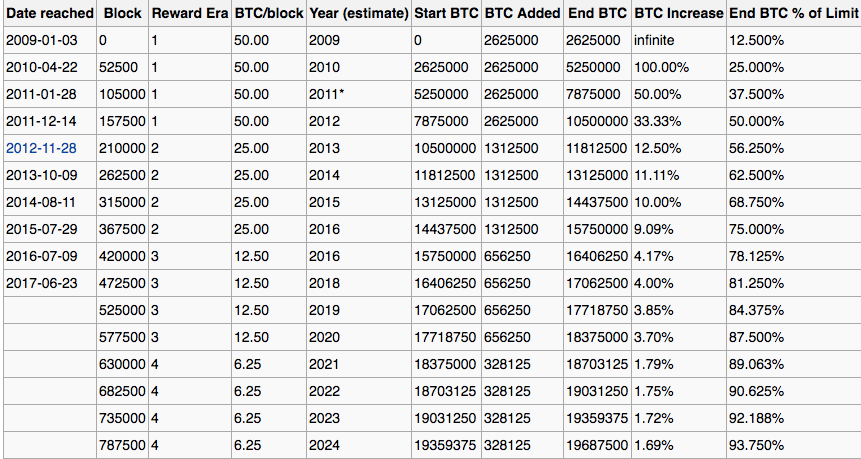
Let’s briefly analyse Bitcoin’s creation and increase of supply. The theoretical total number of Bitcoins is 21 million. Hence, Bitcoin has a controlled supply. Bitcoin protocol is designed in such a way that new Bitcoins are created at a decreasing and predictable rate. Each year, number of new Bitcoins created is automatically halved until Bitcoin issuance halts completely with a total of 21 million Bitcoins in existence.

While the number of Bitcoins in existence will never exceed 21 million, the money supply of Bitcoin can exceed 21 million due to fractional-reserve banking.

Screen Shot 2018-02-09 at 6.04.08 PM

Source: en.bitcoin.it

As of June 23, 2017, Bitcoin has reached a total circulation amount of 16.4 million Bitcoins, which is about 81,25% of the total amount of 21 million Bitcoins.

2017 research by Chainanalysis showed that between 2.78 million and 3.79 million Bitcoins are already lost or 17% – 23% of what’s been mined to date.

Screen Shot 2018-02-09 at 6.41.15 PM

How much Bitcoin exactly has been lost? It’s a pretty tough question considering there is no definitive metric for finding the answer. A good estimate is around 25% of all Bitcoin, according to this analysis (this research concludes 30% of all coins had been lost, equating to 25% of all coins when adjusted for the current amount of coins in circulation, which can be done as bulk of lost Bitcoins originate from very early and as Bitcoin’s value has been going up, people lose their coins at a slower rate).

With advent of quantum computers, future of Bitcoin might be perilous. One researcher suggested that quantum computers can calculate the private key from the public one in a minute or two. By learning all the private keys, someone would have access to all available bitcoin. However, a more extensive research shows that in short term, impact of quantum computers will appear to be rather small for mining, security and forking aspects of Bitcoin.

It’s possible that an arms race between quantum hackers and quantum Bitcoin creators will take place. There is an initiative that already tested a feasibility of quantum-safe blockchain platform utilizing quantum key distribution across an urban fiber network.

The below image shows encryption algorithms vulnerable and secure for quantum computing.

Screen Shot 2018-02-15 at 12.17.48 PM

Source:  cryptomorrow.com

And while work is still ongoing, three quantum-secure methods have been proposed as alternative encryption methodologies for the quantum computing age: lattice-based cryptography, code-based cryptography, multivariate cryptography. IOTA already  deploys Winternitz One-Time Signature (OTS) scheme using Lamport signatures, claiming to be resistant to quantum computer algorithms if they have large hash functions.

The no-cloning theorem will make it impossible to copy and distribute a decentralized ledger of qubits (quantum units of information). As qubits can’t be copied or non-destructively read, they will act more like real coins (no issue of double-spending). Quantum Bitcoin miners might support the network by doing operations which amount to quantum error correction (which might replace current Proof-of-Work or Proof-of-Stake systems) as the use of quantum entanglement will enable all network participants to simultaneously agree on a measurement result without a proof of work system.

And while we are waiting for quantum-era Satoshi to rise, check out this THEORETICAL account of how quantum computers may potentially create Bitcoin, which also contains primers on quantum computers and Bitcoin mining.

P.S. Satoshi is estimated to be in the possession of over one million coins

View at Medium.com